





News

Share
Published 10:43 9 Sept 2026 BST
Updated 11:01 9 Sept 2026 BST
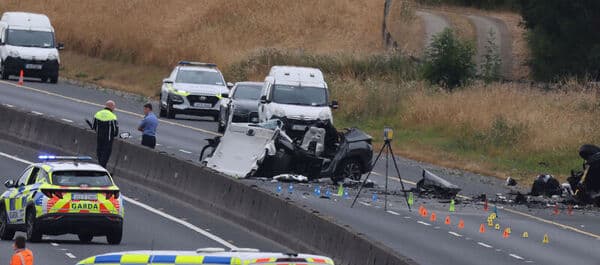
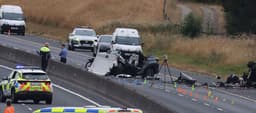
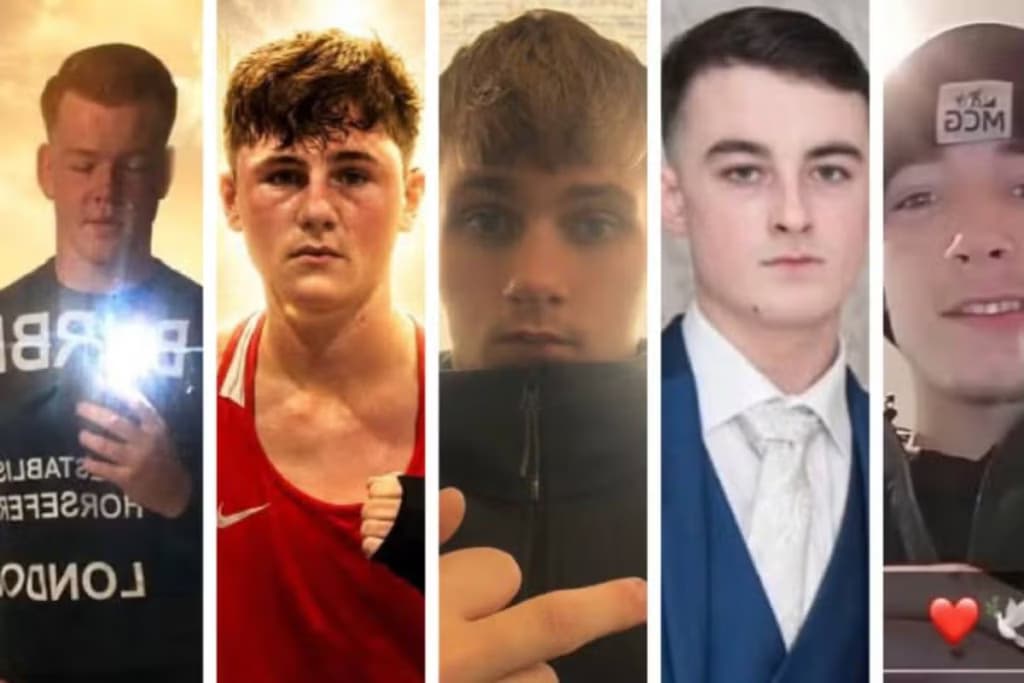
The five boys were driving the wrong way down the motorway when they hit the family on their way to the airport for a holiday at around 3am. Since then the government has been scrambling for someone or something to blame while the public sought answers for how this could happen.
Many who work in some of the communities the boys hail from said that these youngsters had been failed by the state, growing up in poverty and trauma. A Fianna Fail TD called them "thugs".
Here's a comprehensive but not exhaustive list of everything the government has blamed for the M9 crash:
The justice minister Jim O'Callaghan said in the immediate aftermath of the crash that the gardaí will be given “whatever resources they require from government in order to respond to this threat to public safety”.
John Joe O’Connell, vice president of the GRA, told RTÉ’s Morning Ireland that it is standard practice for garda members to stand down a pursuit when a car drives the wrong way on a motorway.
“There are different levels of driver training available to gardaí,” said O’Connell, “but not one of our members are pursuit trained.
“We’re looking for a proper training framework so our members can deal with non-compliant stops, we’ve nobody trained in a non-compliant stop.”
While O’Connell said there are a “huge” number of garda drivers trained in CPD1 – the lowest level of driver training – he added that they “cannot, as per the policy of that driver training, activate blue lights and sirens”.
In relation to pursuit training for gardaí, O’Callaghan said Garda Commissioner Justin Kelly confirmed that training will begin for the first time this year.
The Department of Justice is also producing legislation to protect Gardaí in vehicle pursuits which is being examined by the Attorney General.
Darragh O'Brien said:“I intend to bring forward amendments in the Road Traffic Bill in this quarter, and certainly have it in by the end of the year to protect Gardaí from that type of situation occurring to them, where they would be charged or indeed prosecuted in the pursuit of their duty. That’s something that shouldn’t happen.
“It’s important that we protect our Gardaí and that we ensure that they can go about their job and do their job and aren’t fearful of prosecution. It’s not right that that is the case. It’s a very small number of cases, but it’s still not right that it’s there."
Social media companies bore the brunt of the blame from across the board after the crash, the justice minister called out social media companies for allowing videos showing illegal behaviour to be shared online.
“This is an issue that’s not unique to Ireland," he said.
"This is happening in other countries, young men stealing cars, driving dangerously on the roads, and videoing it for the purpose of social media postings.
He said the social media firms “emphasise in their codes of practice that they will not allow any postings that glorify criminal behaviour” but that “regrettably, that hasn’t been happening.”
“Social media companies need to step up to the mark as well in respect of their own responsibilities,” he said.
Meanwhile a letter written by Fianna Fáil MEP Billy Kelleher and co-signed by 29 other MEPs called on the European Commission to investigate whether social media algorithms are being used to amplify videos of dangerous driving.
MEPs have called for the commission to assess whether platforms have “adequately identified and mitigated the risk that their recommender systems may amplify, normalise, or reward such behaviour, particularly among minors”.
TikTok has declined an invitation to appear before the Oireachtas Committee on Media.
"Both An Garda Síochána and Coimisiún na Meán are conducting their own examinations into the matter," a statement said.
"As a result, we believe it would not be possible to appear before the committee in public session until this process is completed.
"The same issues arises in relation to other social media platforms and messaging services where instances of the content complained of is present."
Barry Andrews suggested banning TikTok from Europe entirely after they would not appear. He then said because the company is Chinese they perhaps "do not fully understand our democratic system."
Minister for State in the Department of Transport Seán Canney said that he was dismayed that the organisation didn't put out a stronger statement.
“I think, could they be more vocal around that? Yes, frankly, and they should have been, and they know that," he said.
Following the crash, the RSA released a statement in which they said they would not comment further on the matter until after the garda investigation had concluded.
It also said it was “not in a position” to provide advice to drivers over what to so when they encounter a car driving the wrong way down the motorway. However, days later the RSA did publish advice on its website.
A decision was made in 2024 to disband the RSA and split the organisation into two separate entities. The government ultimately rolled back on that decision, with the Taoiseach that he was never in favour of splitting the organisation in two, he doesn't believe it would work.
Minister Darragh O’Brien says the RSA needs to "get its act together" when it comes to driving test wait times.
“One is road safety, and actually, road safety relates as well to driver testing,” said O’Brien, who said there have been issues recently around driving test wait times.
“In some areas, that started to slip again, and that’s really frustrating. Like we’ve provided extra resources, i.e., more people in the RSA, more testers, and we’re seeing in certain areas now, that 10-week average going out to 12 weeks and beyond.
“That’s not acceptable. And like, that’s core to their job, and that actually impacts on people’s lives. If you can’t get a driving test, you mightn’t be able to get the job that you’re going for. And I’ve had cases like that myself. So that isn’t acceptable.
“It’s extremely frustrating to see those delays creeping back in, and it isn’t acceptable. We’ve provided them with the resources and the funding, and they need to get their act together on that, frankly.”
This already exists as it would naturally come under legislation for dangerous driving. However, the government's initial suggestion was more laws on the road.
Minister Canney acknowledged this is already an offence but said the penalty “may not be enough”.
He did not reveal what higher penalty may be imposed under the aggravated offence and said it would be discussed with the Attorney General.
The Junior Minister said that those who intentionally drive the wrong way on the dual carriageway or motorway at speed “need to be taken off the road by whatever means we have to do it, and that’s why the legislation would be important to that level.”
“Where you have a situation where the collision is caused deliberately, I think we have to call a halt on that.
“I think it’s important that the sentences are longer in jail...and that there is also, I suppose, an attitude that we will not tolerate this type of behaviour.
“I think we need to make sure that when somebody does something this blatantly wrong and actually is imposing danger on other people, that there are consequences for them,” he said.
Minister Canney said the legislation providing for a new aggravated offence for contraflow motorway driving will be introduced by the end of the year, “we will be bringing in legislation very, very quickly once the Dáil is reconvened.”
The Junior Minister for Road Safety Sean Canney was back again with suggestions when he said there is “an opportunity” to use AI cameras on major motorways to detect people driving on the wrong side of the road.
Minister Canney said the use of technology was discussed in the meeting and added that there is an “opportunity with AI and the camera technology” to help identify contraflow motorway driving.
“The M50, for instance, is well covered with cameras, and down in Cork on the orbital road to Cork, there is a lot of camera networks there.
“What we need to do is to continue, maybe with AI technology to help us detect quicker what’s going on, maybe to have alerts quicker, and also the Gardaí would be better placed to see how they will deal with the procedure,” he said.
Minister Canney said the use of flashing lights and signage to warn those that have accidentally driven the wrong way on a motorway.
“I think we can do things around that fairly quickly in terms of looking at maybe more flashing lights, if somebody comes down, that a light will flash and will alert somebody to it,” he said.
The Tánaiste Simon Harris said the crash showed a “breakdown in respect for authority in society but also respect for the value of your own life and human life.
“There’s a broader issue here: a breakdown in respect for authority in society but also respect for the value of your own life and human life," he said.
"And I think, as a government, some of it’s for government, some of it’s for broader society."
The government have been very quiet on the fact that the number of gardaí involved in Roads Policing Units has dropped by nearly 40% since 2009.
The latest figures released from the Department of Justice and An Garda Síochána show overall personnel has decreased from 1,046 in 2009 to 645 in March of this year - a reduction of 401 specialised gardaí policing Irish roads.
More of this would probably be a good place to start.
Despite all the furore over a "zero tolerance" approach to driving dangerously, poor social media use and a so-called "breakdown of society", there has been barely any mention of the fact that three of the boys were in the care of Tusla and one had spent time in the juvenile detention centre, Oberstown.
The State has never had a dedicated strategy for children in care, despite everything we know about the toll care takes on children's lives.
1,121 children in Tusla care were placed in unregulated emergency settings last year, like hotels and short-term rentals, run by private companies for what is supposed to be short periods of time.
Figures from Tusla show that up to 42 children were missing under their care at one point this year.
19 children known to Tusla died in 2024, including four by suicide.
The deaths decreased by 10 in comparison to 2023 which saw 29 deaths.
People who actually work with children like the boys involved in the crash have explicitly told the government what the issue is.
Minister Jim O’Callaghan has said his department has identified about 1,000 children who are beyond the reach of youth diversion programmes.
Just this month, Ireland’s community and voluntary sector were said to be facing a “crisis of sustainability” that threatens essential public services unless the Government reforms how it funds and supports charities and community organisations.
Speaking on RTÉ's Morning Ireland, Criminologist Trina O'Connor said Ireland needs "to be looking at what is going on in their environment", and "tackle from an early intervention point-of-view".
Community workers say that when diversion programmes are put in, there is only enough funding for three months.
"Pilot programmes do so much good, but when they are whipped out of a community, it actually does harm," she said.
"We need to support young people through that journey of adolescence where they may be involved in criminal drift, or they might be vulnerable to criminal grooming.
"We need to support them entirely right through and maintain the staff that are put in place from An Garda Síochána to people within community-based training.
"We have to ensure that we, as the State, can stand in and put the scaffolding around them young people to move them towards pro-social behaviour by giving them good role models and by giving them consistency of care," she said.
Likewise, People Before Profit councillor Hazel De Nortúin said:
"In communities like Ballyfermot, we've exhausted ourselves explaining to Ministers that community organisations, when at the forefront of responses to situations like childhood crime - in this instance, have the best outcomes with prevention," she said.
"If we're serious, we need to get to a place of prevention instead of looking at custodial sentences as a prevention because that's not where these kids heads are at.
In the lives of these kids, they've shown to have a very complex family background that needs the expertise of family supports that in collaboration with state agencies, has the most effective outcome in crime prevention. In some cases, you can trace where a child was missed by early intervention because of large waiting lists for assessments and never catches up with the school system and slowing disengages."
Explore more on these topics:


News
News

News
Twelve countries join Ireland announcing bans on trade from illegal Israeli settlements
Ireland, Spain, Norway, Belgium and the Netherlands have already banned trade from settlements. In a sweeping blow to Netanyahu’s Israeli government, Canada, Denmark, Finland, France, Iceland, Norway, Poland, Portugal, Spain, Sweden and the UK have confirmed their intention to introduce national and/or support European restrictions on trade in goods with settlements which are illegal under […]
News
18h
More than 200,000 children living below the poverty line in Ireland, new ESRI report finds
10% of children under 16 experienced child-specific deprivation in 2024. More than 200,000 children in Ireland were living in households below the poverty line in 2024, according to new research from the Economic and Social Research Institute (ESRI). The figure represents 17.4% of children, an increase of almost 30,000 children since 2021. The poverty line is defined […]
News
21h
News
Tributes paid to young boy and footballer who died in Mayo car-train crash
News