









Life

Share
Published 12:42 24 May 2021 BST
As noted in Linda Geddes' story for The Guardian, dogs' powerful mucus plays an important part in this super accurate, rapid detection. Their mucus dissolves odour molecules from the air and transports them to olfactory receptors in the top of their nose, before sending the signal to the brain. While humans have about 5 million of these receptors, dogs have up to 300 million.

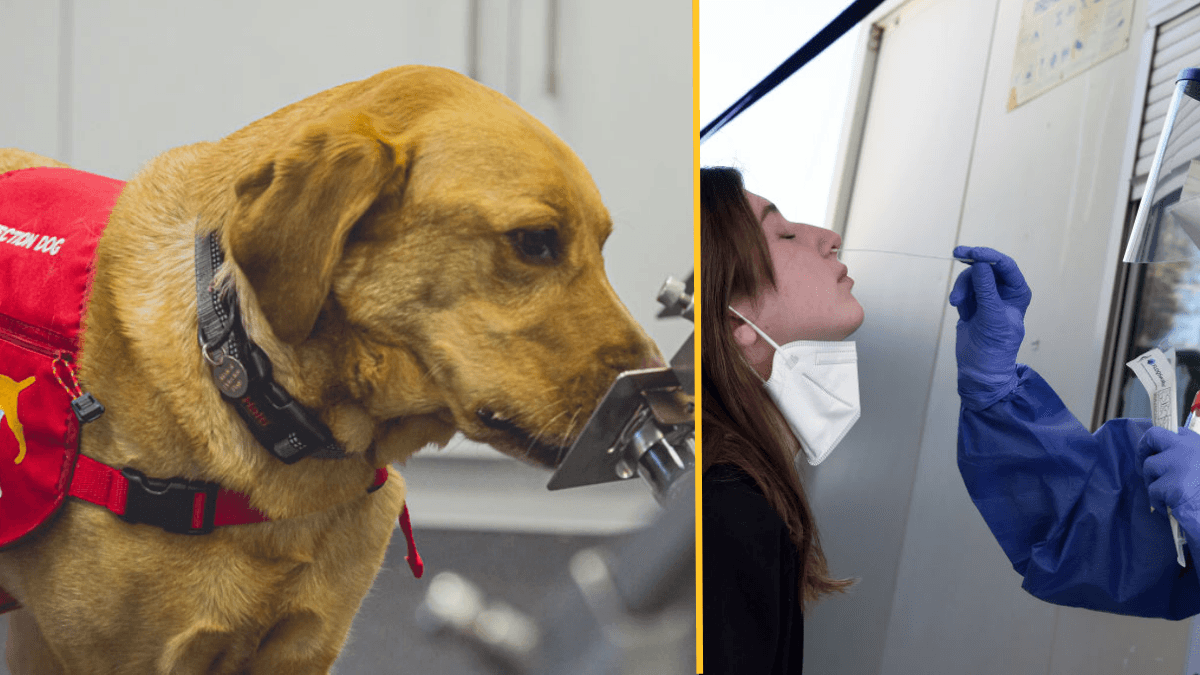
In conclusion, the study found that dogs could detect Covid-19 on clothing with up to 94.3% sensitivity, meaning they would correctly identify 94 out of every 100 people infected with the virus.
Furthermore, in addition to their unparalleled speed (under a second), the successfully sniffed socks included "people who are asymptomatic and also people with a low viral load,” according to Professor James Logan, who co-led the study. That level of accuracy and speed across 3,500 samples. Incredible stuff.
Of all six Covid detection dogs, a three-year-old golden labrador named Tala was the most accurate sniffer, achieving 94.5% sensitivity, and a specificity of 92% – i.e. the proportion of uninfected people that he would correctly identify. Well done, Tala!
MDD says that it takes around eight to ten weeks to train a Covid-19 detection dog. They are, of course, rewarded for their heroic efforts with a treat or some other kind of positive reinforcement like a ball. Most miraculously, this isn't even the only site where tests like this are taking place, with Finland, France, Lebanon and Italy all using our beloved pets for Covid-19 detection. [caption id="attachment_273809" align="alignnone" width="1024"] Covid detection dog being trained in Rome[/caption]
The charity's CEO, Dr Claire Guest, has a long history with dogs, having worked with Hearing Dogs for Deaf People, before founding MDD in 2008. It was during this time that she met a woman who claims her pet dalmatian diagnosed a malignant melanoma on her calf. Amazing.
Dogs have long been linked to detect illnesses including cancer and, recently, even malaria - Covid detection dogs are simply the next step. Back in 2002, Guest and orthopaedic surgeon, John Church, also proved that dogs can distinguish between urine from healthy people and those with bladder cancer.
Co-lead Logan believes that "dogs could be an additional tool that could be used as part of a kit to address the things that PCR and lateral flow tests can't do. For example, dogs can screen people very quickly so they could be used in circumstances such as airports, or other public gatherings, stadiums, where lots of people have to be screened very quickly."
Going simply off the same model and findings garnered from this study, it is estimated that dogs like these could be used at airports and other entry points into different countries to screen around 300 people in 30 minutes. Not all heroes were capes. Some wear collars.
We don't need more reasons to love dogs more than we already do: they are simply the greatest creatures on earth - this research is yet more proof of that universal truth. High five (paw) to each and every one of you Covid detection dogs and all those involved.

Life

Life

Life

Life
Irish driver baffled by neighbour who moves their car every time they move theirs
“It doesn’t matter where I park they will move their car there as soon as I leave” A Reddit user has been left completely baffled by a neighbour who appears to follow them around their apartment car park. The resident explained that their apartment complex, where they have lived for seven years, has plenty of […]
Life
1 week ago
Medical expert explains when erectile dysfunction is worth getting checked
Erectile dysfunction is something many men will experience at some point in their lives, and an occasional issue getting or maintaining an erection isn’t necessarily cause for concern.1,2 However, a health expert has explained when a change in erectile function should be checked out – and how it could potentially tell you something important about […]
Life
2 weeks ago
Why do we get goosebumps and where do they come from?
Life