







Life

Share
Published 16:30 23 Aug 2026 BST
Updated 16:30 23 Aug 2026 BST
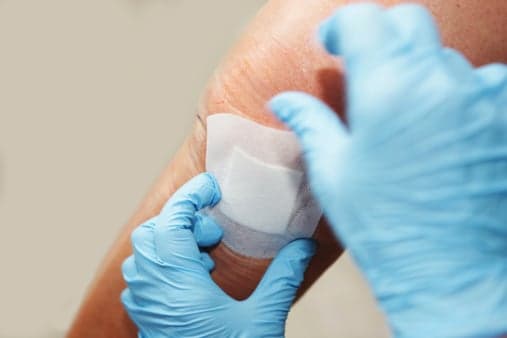
A dissolvable, 3D-printed skin cancer patch developed by researchers in Belfast could make treatment for localised skin cancer simpler and considerably less painful.
Created at Queen’s University Belfast, the small patch carries tiny microneedles that pass through the outer layer of the skin without drawing blood.
The microneedles deliver two anti-cancer drugs, curcumin and 5-fluorouracil, straight to the affected area.
By putting the medicine exactly where it is needed, the researchers say the approach offers more targeted delivery and could cut the need for repeated topical treatments or more invasive procedures such as injections.
The team developed a one-step 3D-printing method that blends both drugs directly into a printable resin before the microneedle patch is made.
It is said it allows better skin penetration, higher drug loading and a controlled two-stage release.
The research was carried out by Rutuja N Meshram, a final-year PhD student, and Professor Dimitrios A. Lamprou, chair of Biofabrication and Advanced Manufacturing, both of the School of Pharmacy at Queen’s.
Because the microneedles dissolve after use, Professor Lamprou added, they may also reduce the risk of needle-stick injuries and cut medical sharps waste, a practical gain for hospitals on this island already managing pressure on resources.
The development was reported by both RTÉ News and the Irish Mirror on Sunday.
The researchers believe the same technique could support the next generation of medicine delivery technologies, including vaccines and other life-saving drugs.
For now it remains a research advance rather than an approved treatment, but it is a notable one to have come out of a pharmacy school in Belfast.
Explore more on these topics:
"Skin cancer is a major public health concern, and current treatments often require repeated topical applications, invasive procedures, or can cause unwanted side effects," said Lamprou.
"Many people also experience fear, discomfort, or inconvenience when treatments involve needles and injections.
"Minimally invasive microneedle systems that dissolve after application could provide a more patient-friendly, simpler and less painful way to deliver cancer medicines."
Life

Life

Life

Life
Irish driver baffled by neighbour who moves their car every time they move theirs
“It doesn’t matter where I park they will move their car there as soon as I leave” A Reddit user has been left completely baffled by a neighbour who appears to follow them around their apartment car park. The resident explained that their apartment complex, where they have lived for seven years, has plenty of […]
Life
1 week ago
Medical expert explains when erectile dysfunction is worth getting checked
Erectile dysfunction is something many men will experience at some point in their lives, and an occasional issue getting or maintaining an erection isn’t necessarily cause for concern.1,2 However, a health expert has explained when a change in erectile function should be checked out – and how it could potentially tell you something important about […]
Life
1 week ago
Why do we get goosebumps and where do they come from?
Life