





Crime

Share
Published 14:02 11 Apr 2026 BST
Updated 16:03 11 Apr 2026 BST
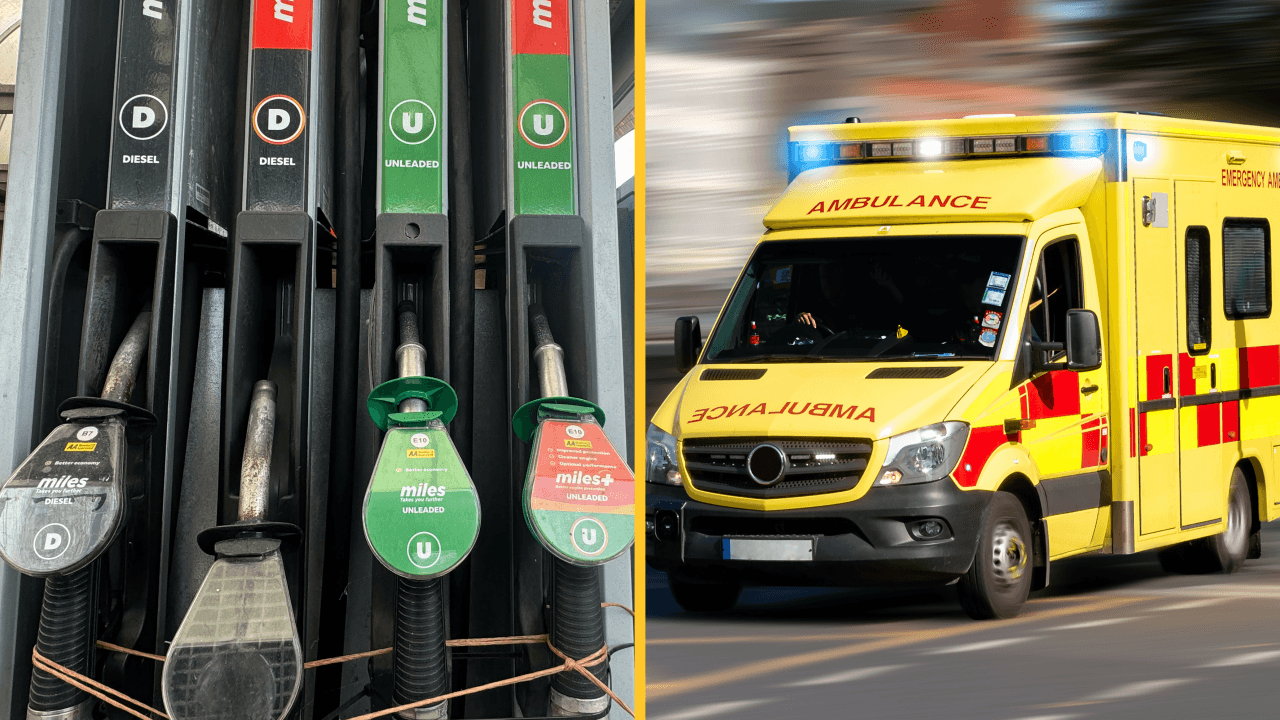
The Irish Government has said that ambulance and fire services are to be 'curtailed' due to the pressure on fuel supplies caused by the ongoing fuel blockades.
As part of this, responses to non-life-threatening callouts from fire services will be "restricted", as will "inter-hospital transfers and ambulance transport services for routine care and discharges" from the National Ambulance Service.
In a statement on Friday evening (10 April), the Department of the Taoiseach confirmed that the National Emergency Coordination Group (NECG) met that day to assess the impacts of blockades on the provision of vital services.
The NECG brings together all relevant Government departments and State agencies to coordinate the response to emergencies.
On Saturday afternoon (11 April), two national fuel depots at Shannon Foynes Port and the Port of Galway, and Ireland's only oil refinery at Whitegate, remain restricted due to the blockades, with movement at the three sites extremely limited.
As a result, fuel supplies for emergency response vehicles, including those of the National Ambulance Service and fire services, are under increasing pressure.
These vehicles rely on retail fuel forecourts for their fuel supply through the use of fuel cards, the Department of the Taoiseach said on Friday evening.
Image via Gov.ie
"The NECG heard that from today, fire services across Ireland have had to put in place contingencies to manage the restricted availability of fuel," the statement from the Taoiseach's department added.
"Fire services will cease non-essential activities (for example, training activities), and responses to non-life-threatening call-outs will be restricted in order to preserve fuel.
"The NECG was also informed of serious concern about the impact that fuel supply shortages are having on the National Ambulance Service.
"Contingency arrangements have been put in place to manage the impact of fuel supply shortages.
"While the National Ambulance Service continues to respond to 999 calls and life-threatening and clinically urgent calls, inter-hospital transfers, and ambulance transport services for routine care and discharges are being curtailed.
"A subgroup of the NECG has been established to coordinate contingency measures to address the fuel supply issues facing emergency services."
Speaking to RTÉ News on Saturday, Health Minister Jennifer Carroll MacNeill said that though ambulances were refuelled overnight, there is concern about what happens "over the weekend and into next week".
She said: "I want people to be aware that our health service is working. It's functional. If you need care, please come for care.
"Please don't defer care. We want you to come. If you need an ambulance, call an ambulance. Our healthcare system is working.
"What we're concerned about is where this goes over the weekend and into next week. What we're concerned about is things that we hope don't happen.
"We are concerned... that were this to continue, we would have difficulty, for example, in getting chemotherapy treatments delivered to hospitals.
"We are concerned that were this to continue, we would have difficulties, for example, with laundry services to support the running of acute hospitals.
"We're concerned that, were this to continue, that we would have difficulty not for the ambulances themselves but for the staff of the National Ambulance Service who need to get to the ambulances, to be able to do that in their own private transportation.
"These are the types of concerns we are worried may come into being in the early part of next week, were this to continue.
"So again, I would ask everybody to please step down from this and to enable the normal transportation that we... are accustomed to and that people are entitled to around the country in the interest of patient safety."
To ease local fuel supply issues, the Taoiseach's Department on Friday evening urged the public to "only buy the fuel they need".
It has also warned people that storing fuel at home or in unsafe locations "presents significant safety risks".
There are around 1,500 to 1,600 filling stations located in the Republic of Ireland, of which 600 are estimated to be currently out of fuel due to the protests.
"That will grow quite dramatically," Fuels for Ireland CEO Kevin McPartlan told RTÉ's The Business on Saturday morning.
"If everything remains as it is, that is to say that the three facilities remain blockaded, then I don't think we could guarantee fuel at any forecourt by very early next week, Monday morning or Monday perhaps."
Main image via Rolling News
Explore more on these topics:


Crime

Crime

Crime

People with one of these 100 surnames could be related to the Royal Family
You may just have royalty in your blood… People with one of these 100 surnames could be related to the Royal Family. If you ever thought you may have royalty in your blood, those with these 100 surnames could be dead right! The surname of the current Royals, Mountbatten-Windsor, tends to fly under the radar, […]
Crime
just now
Dozens of families in DePaul accommodation to be evicted three weeks before Christmas
Residents include a one week old baby and a woman receiving cancer treatment. Dozens of women and children in a Dublin inner-city homeless accommodation service are set to be evicted just before Christmas. 36 people live there in total. 15 children including a week-old baby. DePaul have known that the closure could happen and originally […]
Crime
15h
Crime
Crime