







Life

Share
Published 10:03 2 Jul 2026 BST
Updated 10:03 2 Jul 2026 BST
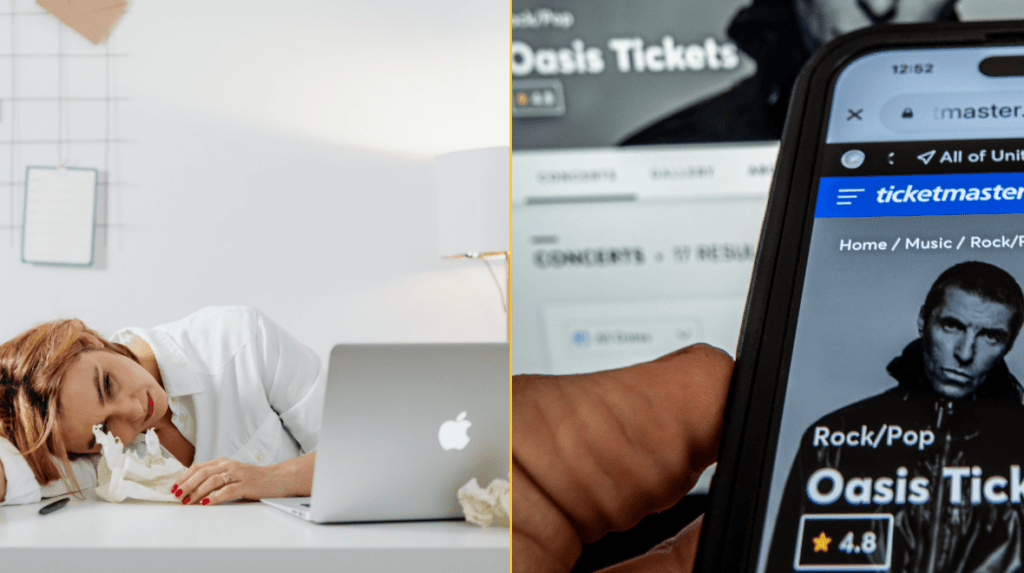
We've all been there, it's 8.55am, and your Ticketmaster account is open and ready to go. You've got your card details ready and you've joined the waiting room with plenty of time to spare.
Then 9am rolls around, and a number so big you didn't even know it existed pops up on your screen. A couple of minutes later you receive the dreaded message: 'this sale now has low availability'
Within minutes, standard tickets are gone, all that's left are premium seats costing hundreds of euro, and social media is full of people asking the same question - how was it sold out before I even got in?
Be it Oasis, Sabrina Carpenter or a in demand sports match, between presales, online queues and skyrocketing prices, it's no wonder fans are left disappointed.
So, here's what's actually going on.
One of the biggest misconceptions is that getting into the waiting room first guarantees you'll be first in the queue.
For most major ticket sales, that's not how it works.
Generally, anyone who joins the waiting room before tickets go on sale is given a random place in the queue once sales begin.
So whether you logged on 20 minutes before or two minutes before, your position tends to be down to chance rather than speed.
In saying this, there is a theory that while the queue numbers are random, Ticketmaster can favour the same accounts each time.
While there is no concrete evidence of this, and it has been denied by the ticketing site, hundreds of ticket buyers have put it to the test, and the results are hard to argue with.
So, if you know someone who always has 'luck on their side' and gets ridiculously low numbers, maybe make a truce to use their account for ticket wars going forward.
Once you're in the queue, it's important to stay there. Once you've received a number, fefreshing the page or trying to open multiple tabs can actually work against you, and cause you to lose your place, or be detected as a bot and be restricted all together.
Sticking with your number is the best bet, and sometimes patients can win the race, but most of the time, especially for arena gigs, even if there are only 10,000 people ahead of you, that doesn't necessarily mean there are only 10,000 tickets available.
Most people can buy several tickets in one transaction, meaning thousands of seats can disappear within minutes.
Moreover, tickets can often be held in customer's baskets while they complete their payment, meaning these tickets won't show up for you even though they have techincally not yet been bought.
However on this point - if you finally get into the tickets page, don't just give up because if they purchases are abandon or payment fails, the tickets are released back into the system.
Hack: keep changing your preferences (i.e. ticket type, price, quantity) to refresh the ticket page without starting a complete page refresh.
It can be a waiting game of sorts, but never give up until the 'sold-out' banner is slapped on; and even then...
Not always, and mostly no.
During presale, sometimes tickets are released in batches every 10-30 minutes, meaning your search could find no tickets at 10.15am, and then could find several at 10.30am. Keep going.
By the time general sale begins, a chunk of tickets may already have been allocated through various presales.
These can include artist fan clubs, venue members, promoter mailing lists, sponsor offers and credit card partnerships.
That means the number of tickets available when the public sale opens can be much lower than people expect.
Even after an event is labelled 'sold out', more tickets can still appear.
Sometimes it's because tickets have been released from abandoned baskets, other times it's because production holds seats/space until the final stage layout is confirmed, after which more tickets can be released. This is typically in the months/weeks leading up to the gig.
It's also worth keeping an eye on official resale platforms, where fans who can no longer attend are able to sell their tickets at face value or within price limits set by the ticketing company. These are your best route if you miss out in general sale.
Once again, in the months/weeks/days leading up to the gig these become most plentiful.
If you've been to a concert recently, you've probably noticed that while the typical cost of a concert ticket used to be around €60, it's now often double that.
There's may reasons for this, starting with the fact that for many artists, touring has become their biggest source of income at a time when streaming generates relatively little money.
At the same time, the cost of putting on a live show has increased dramatically.
Think of it this way - just as the cost of materials to build a house has risen dramatically the cost materials to build houses has drastically increased, so has the price of the home.
Transporting equipment around the world, hiring crews, paying security, covering insurance and building increasingly elaborate stage productions all come at a price.
As well as this, there are booking fees, venue costs and, for some events, dynamic pricing, where ticket prices can rise depending on demand.
The reality is that before tickets reach fans, the cost of staging a major concert is significantly higher than it was just a few years ago.
That said, artists do have some control on pricing, as they can choose whether dynamic and platinum pricing in enabled during ticket sales. Unfortunately, 99% of the time it is.
While there's no guaranteed way to beat the queue, there are a few things that can improve your chances.
The best bet is getting access to a presale, whether that's through an artist, promoter or sponsor.
Another way to improve your chances is to set up your ticketing account well before sale day and make sure your payment details are saved. This saves time on the day of sale and makes the checkout process much smoother.
On the day itself, the waiting room generally opens 15-30 minutes ahead of sale. Make sure to join before sale time and avoid refreshing once you've got your number. (Refreshing every 5 seconds between the clock striking 9am and getting your number is another unproven theory, chance it at your own risk.)
Use a reliable internet connection, have a backup payment method ready and, if possible, be flexible about where you're willing to sit or stand.
If standard tickets disappear immediately, don't give up. Keep an eye on the platform the day of the sale, and then for official resale platforms afterward.
Also, be sure to watch out for additional ticket releases or even extra dates being added to particularly in demand tours.
While getting tickets might never be completely stress-free, knowing how the system works may make it a bit less of a mystery next time!
Explore more on these topics:
Hack: 90% of the time if an artist is running an album presale, there is a no purchase necessary option of their site. This means you don't have to pay to pre-order the artists new album to receive a presale code, you just enter your email and address and you receive access the exact same sale. Be it, the no purchase necessary option is often very discretely advertised, and usually appears in tiny writing on the top or on the bottom of the artist's website.
Life

Life

Life

Life
Irish driver baffled by neighbour who moves their car every time they move theirs
“It doesn’t matter where I park they will move their car there as soon as I leave” A Reddit user has been left completely baffled by a neighbour who appears to follow them around their apartment car park. The resident explained that their apartment complex, where they have lived for seven years, has plenty of […]
Life
1 week ago
Medical expert explains when erectile dysfunction is worth getting checked
Erectile dysfunction is something many men will experience at some point in their lives, and an occasional issue getting or maintaining an erection isn’t necessarily cause for concern.1,2 However, a health expert has explained when a change in erectile function should be checked out – and how it could potentially tell you something important about […]
Life
1 week ago
Why do we get goosebumps and where do they come from?
Life